
Jira is powerful, but its default workflows often fall short in complex, multi-team environments. A simple "To Do -> In Progress -> Done" structure might work for a small team, but it breaks down when managing intricate developer-to-QA handoffs, multi-stage release cycles, or detailed customer onboarding processes. Generic workflows create ambiguity, hide critical blockers, and lead to manual work that drains your team's productivity. The result? Dropped balls, inconsistent quality, and frustrated engineers who spend more time updating tickets than writing code.
This guide moves beyond the basics. We've compiled a list of seven resources offering robust, actionable Jira sample workflows designed for real-world, cross-functional scenarios. You won't just see diagrams of states and transitions. For each resource, we provide a strategic breakdown, including:
- Actionable insights for implementing quality gates and blockers.
- Tactical tips for automating handoffs and status updates.
- Screenshots and links to see the templates and tools in action.
Our goal is to help you transform your Jira instance from a simple task tracker into a predictable, automated engine for cross-team delivery. Use these examples as a launchpad for your own internal improvements. For a broader understanding of how to drive this kind of change within your organization, you can explore various process improvement strategies and best practices. Let's dive into the workflows that will help you build more efficient, transparent, and scalable processes.
1. Harmonize Pro
Harmonize Pro offers a powerful Jira app, Nesty, that transforms standard Jira issues into dynamic, self-managing workflows. Instead of merely providing static documentation or external examples, Nesty enables teams to build and automate complex processes directly within Jira, making it an exceptional resource for anyone looking to implement robust, real-world Jira sample workflows. This approach moves beyond theoretical diagrams and embeds sophisticated, multi-step handoffs and quality gates into your live project environment.
What truly sets Harmonize Pro apart is its ability to eliminate the manual coordination that plagues cross-functional teams. Nesty uses a combination of unlimited nested checklists and smart triggers to orchestrate complex sequences, such as Dev→QA handoffs, multi-environment deployments, and structured customer onboarding, all from a single Jira ticket. This provides unparalleled traceability and reduces the risk of human error.
Key Features and Strategic Advantages
Harmonize Pro’s Nesty is more than just a workflow template provider; it's a process automation engine for Jira. Its capabilities are designed to enforce standards and streamline collaboration with precision.
- Automated Cross-Team Handoffs: Nesty can automatically reassign a ticket to the next team, send a notification in Slack or Microsoft Teams, and attach required artifacts (like build packages or design documents) once a set of prerequisite tasks is complete. This solves the common problem of tickets stalling between process stages.
- Dynamic Checklists and Quality Gates: You can create unlimited nested checklists to model intricate processes. Smart triggers can enforce a "Definition of Done" by preventing a ticket from moving to the next status until all required checklist items are complete. This creates reliable quality gates that ensure no steps are missed.
- Centralized Workflow Management: By orchestrating multi-step cascades from one Jira ticket, Nesty ensures complete visibility and auditability. For example, a single "New Feature" ticket can manage development, QA testing, staging deployment, and production release phases, with each phase unlocking only when the previous one is successfully finished.
- Pre-built Templates and Documentation: To accelerate adoption, Harmonize Pro provides comprehensive documentation and pre-built workflow examples. These serve as excellent starting points for teams looking to codify best practices for common scenarios like bug triage or release management.
Actionable Takeaway: Start by implementing Nesty for a single, high-friction workflow, such as the handoff between your development and QA teams. Use the automated triggers to enforce your "Definition of Ready" for QA. Require developers to attach unit test results and confirm a successful build before the ticket can be reassigned to the QA team, eliminating back-and-forth communication.
Real-World Application and Use Cases
The practical benefits of Harmonize Pro's Nesty are immediately apparent in complex, multi-team environments.
| Use Case | Nesty Implementation Example |
|---|---|
| Software Release Management | A single "Release" ticket can contain nested checklists for build generation, deployment to staging, QA sign-off, and production deployment, with automated triggers managing each handoff. |
| Customer Onboarding | Onboarding tickets can be structured with phases for kickoff, technical setup, user training, and final review, with client-facing checklist items and internal tasks managed in one place. |
| Bug Triage and Resolution | A bug report can trigger an automated triage checklist, assign it to a product owner for prioritization, and then route it to the correct development team based on specified criteria. |
Access and Pricing
Nesty is an app for Jira and can be installed via the Atlassian Marketplace. Pricing details are not publicly listed on their website, so you will need to contact Harmonize Pro directly or check the marketplace listing for licensing information. While this requires an extra step, the platform's focus on enterprise-grade process automation suggests it is positioned for teams where reducing coordination overhead and enforcing process standards deliver significant ROI.
Website: https://harmonizepro.com/nesty
2. Atlassian Jira Automation Template Library
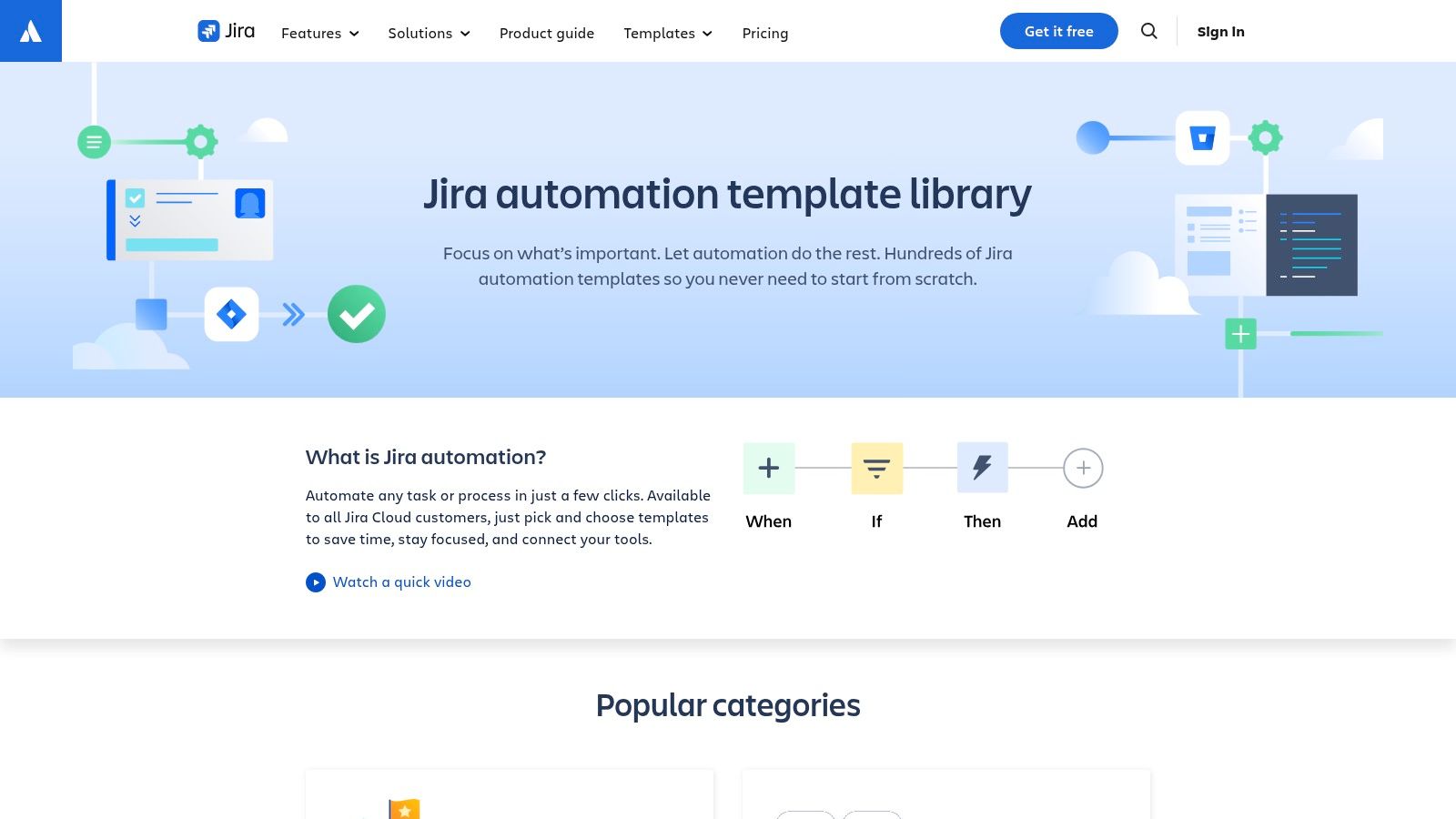
For teams seeking to implement proven jira sample workflows without building them from scratch, the Atlassian Jira Automation Template Library is the most direct starting point. Instead of providing full, complex workflow diagrams, it offers a massive, searchable gallery of pre-built automation rules that represent the "connective tissue" of any effective workflow. These are the triggers, conditions, and actions that move work forward automatically.
The library allows users to filter hundreds of templates by categories like Software, Business, ITSM, and DevOps. This approach lets you find specific, actionable pieces of a workflow, such as automatically transitioning an issue when a pull request is merged or notifying a Slack channel when a high-priority bug is created. Its native integration within Jira Cloud is a significant advantage, eliminating the need for third-party apps for most common automation tasks.
Strategic Breakdown and Actionable Insights
What makes this resource unique is the "Automation Playground," a sandbox environment where you can test any rule without affecting your live projects. This feature is invaluable for preventing misconfigured rules from causing chaos in your production Jira instance. You can safely experiment with triggers and see their outcomes before committing.
Key Takeaway: Start with the "Most popular" templates for your category (e.g., Software). These often solve the most common process bottlenecks, like auto-assigning sub-tasks or syncing parent and sub-task statuses, providing immediate value with minimal setup.
Features, Pros, and Cons
| Feature | Description |
|---|---|
| Automation Playground | A safe sandbox environment to test rules before enabling them in production projects. |
| Native Integration | Built directly into Jira Cloud, requiring no extra marketplace apps. It integrates seamlessly with Slack, MS Teams, and major Git hosts. |
| Template Gallery | Hundreds of searchable, pre-built automation rules categorized for different team types (Software, ITSM, Business). |
| Rule-Based Customization | While templates are a starting point, each rule is fully customizable to fit your team's specific transitions, fields, and conditions. |
Pros:
- Speed to Implementation: The fastest way to add powerful automation to existing workflows.
- Proven Patterns: Based on the most common automation patterns used by thousands of Jira customers.
- Ecosystem Integration: Tight, out-of-the-box connections to Bitbucket, GitHub, GitLab, Slack, and Teams.
Cons:
- Execution Limits: Free and Standard Jira plans have monthly execution limits; heavy users may need Premium or Enterprise tiers.
- Complexity Ceiling: Extremely complex, multi-system orchestrations might still require a more powerful marketplace app or custom scripting.
How to Access
The library is available to all Jira Cloud users directly within the product. To access it, navigate to Project Settings > Automation > Templates. Learn more about how these templates can form the backbone of a powerful workflow in our guide to Jira workflow automation. It's a foundational resource for anyone looking to make their Jira processes more efficient.
Website: Atlassian Jira Automation Template Library
3. Atlassian Jira Workflow Templates and Guides
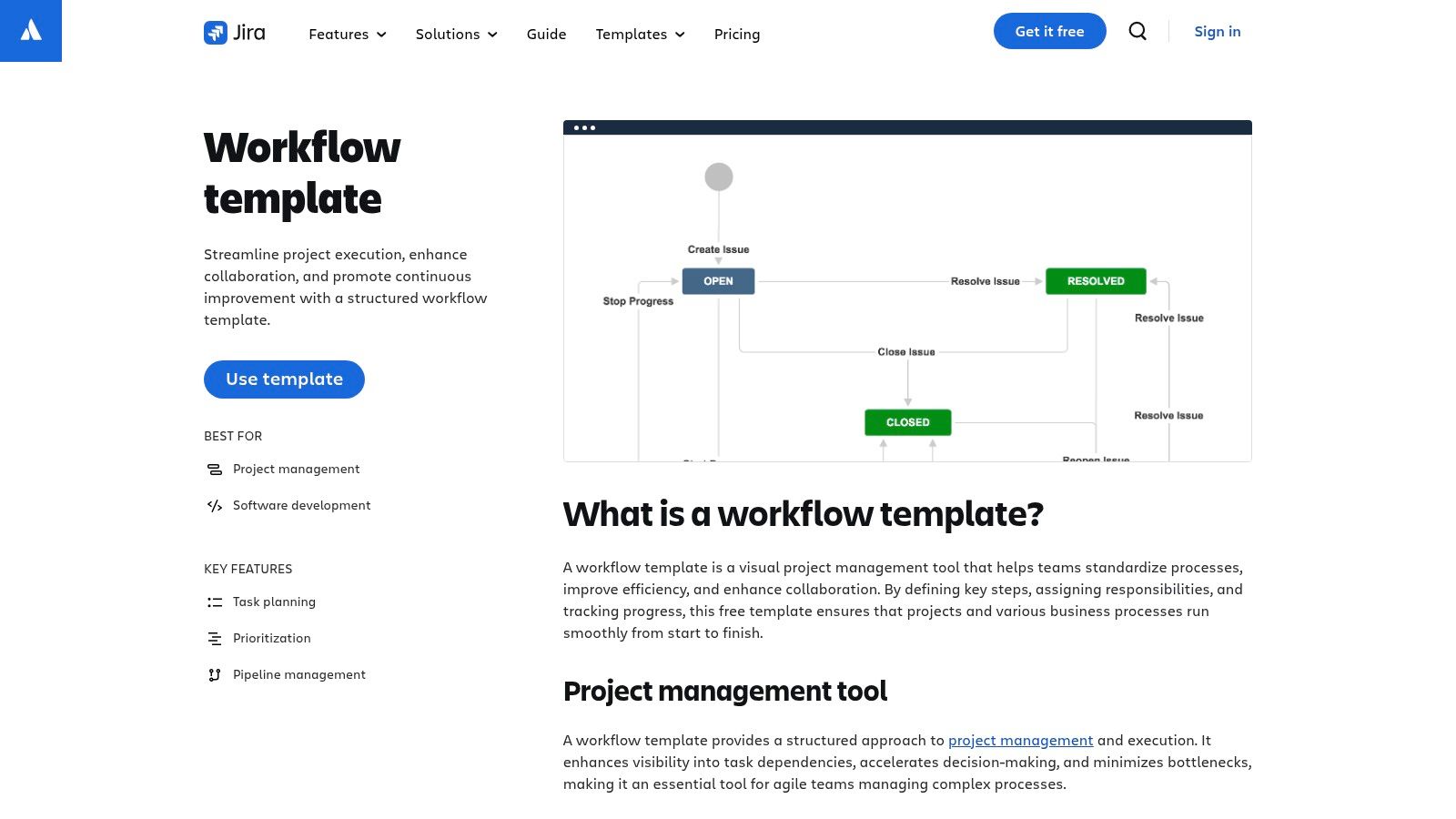
For teams needing foundational jira sample workflows and project structures, Atlassian’s own library of workflow and project templates is the official starting point. Unlike the granular automation rules library, this resource provides complete, ready-to-use project templates for Scrum, Kanban, and bug tracking. These templates come with pre-configured workflows, issue types, and board settings, offering a holistic framework for new projects.
This official hub is designed to reduce initial setup friction, providing teams with a reliable, Atlassian-endorsed structure. It guides administrators and project leads through the essential components of a functional workflow, from defining statuses like "To Do," "In Progress," and "Done" to configuring the transitions that connect them. It’s an ideal resource for standardizing practices across an organization or for teams just beginning their Jira journey.
Strategic Breakdown and Actionable Insights
What sets this resource apart is its focus on project-level templates rather than just workflow diagrams. When you select a template, such as the "Scrum software development" project, Jira provisions not only the workflow but also the associated Scrum board, sprint functionality, and relevant reports. This integrated approach ensures all necessary components are in place from day one, preventing common setup errors.
Key Takeaway: Always use an official template as your baseline, even if you plan to customize it heavily. This ensures your workflow is built on a stable, supported foundation. Start with the template that most closely matches your team's methodology (e.g., Kanban for continuous flow, Scrum for iterative development) and then modify statuses and transitions, rather than building from a completely blank slate.
Features, Pros, and Cons
| Feature | Description |
|---|---|
| Project-Level Templates | Provides complete project setups, including workflows, issue types, screens, and board configurations for Scrum, Kanban, and business use cases. |
| Step-by-Step Guidance | Includes official documentation and best-practice guides directly linked from the templates, explaining the purpose of each status and transition. |
| Software & Business Focused | Offers dedicated templates for software development (bug tracking, Scrum) and business projects (project management, task tracking), covering common organizational needs. |
| Native Jira Integration | As an official Atlassian resource, these templates are accessed and deployed directly within the Jira "Create Project" interface, ensuring seamless implementation. |
Pros:
- Drastically Reduces Setup Time: The fastest way to launch a fully configured, best-practice project in Jira.
- Official and Supported: Built and maintained by Atlassian, ensuring compatibility and alignment with Jira's core features.
- Establishes Consistency: Helps organizations enforce standard workflows and terminology across different teams.
Cons:
- Intentionally Generic: The workflows are designed to be broadly applicable and may require significant customization for specialized or mature teams.
- Limited Complexity: These templates provide a basic structure and often need to be enhanced with more advanced conditions, validators, and post functions for robust processes.
How to Access
These templates are available for free to all Jira Cloud and Data Center users. They can be accessed directly within Jira by navigating to Projects > Create project. From there, you can browse the library of software, business, and service management templates. To understand how to evolve these basic structures, explore our guide on Jira workflow best practices, which details how to customize and scale these foundational templates.
Website: Atlassian Jira Workflow Templates
4. ScriptRunner for Jira (Adaptavist)
When standard Jira automation and workflows hit their functional limits, ScriptRunner for Jira by Adaptavist becomes the go-to solution. It's a powerful scripting and automation engine that enables teams to build highly customized and complex jira sample workflows using Groovy scripts. Rather than relying on a visual-only builder, ScriptRunner provides a code-first environment where you can implement sophisticated logic, advanced approvals, and cross-project orchestration that native Jira cannot handle alone.
ScriptRunner's strength lies in its extensive library of workflow enhancements, including post-functions, validators, and listeners. These components allow you to create dynamic and conditional workflows based on specific criteria, such as checking linked issue statuses before a transition, calculating field values automatically, or integrating with external APIs as part of a workflow step. It's the definitive tool for teams needing to enforce strict business processes or automate intricate, multi-step procedures directly within their Jira instance.
Strategic Breakdown and Actionable Insights
The most powerful aspect of ScriptRunner is its ability to create custom workflow validators. These are rules that must be met before a user can transition an issue, acting as powerful quality gates. For example, you can write a validator that prevents a "Ready for QA" transition unless all linked sub-tasks are resolved and the "Code Reviewer" field has been populated. This moves process enforcement from a manual checklist into an automated, unbreakable part of the workflow.
Key Takeaway: Start by exploring ScriptRunner's built-in script library. Find a simple validator, like "Ensure a field is not empty on transition," and apply it to a non-critical workflow in a test project. This provides a low-risk entry point to understanding how scripts interact with your workflows before tackling more complex automations.
Features, Pros, and Cons
| Feature | Description |
|---|---|
| Advanced Workflow Functions | Extends Jira workflows with scripted post-functions, conditions, and validators to enforce complex business rules and logic. |
| Code-First Flexibility | Uses the Groovy scripting language, giving developers full control to implement advanced, policy-driven workflows and integrations. |
| Example Scripts & Recipes | Provides a vast library of ready-to-use scripts and detailed use cases for common problems like conditional transitions and field manipulations. |
| Support for Cloud & Data Center | Offers tailored versions for both Jira Cloud and Data Center, with dedicated support and migration resources available for each platform. |
Pros:
- Handles extremely complex, conditional workflows that exceed native Jira automation capabilities.
- Enables deep integration with external systems via API calls within workflow transitions.
- Scales effectively from small teams implementing specific rules to large enterprises with complex governance needs.
Cons:
- Requires a learning curve for those unfamiliar with Groovy scripting to implement advanced use cases.
- Pricing, sold via the Atlassian Marketplace, can increase significantly for higher user tiers, becoming a notable expense.
How to Access
ScriptRunner for Jira is available on the Atlassian Marketplace for both Cloud and Data Center instances. You can start with a free trial to explore its capabilities within your own Jira environment. The Adaptavist Library is an excellent resource for finding script examples and patterns that can be adapted to build your own powerful jira sample workflows.
Website: ScriptRunner for Jira (Adaptavist)
5. JMWE – Jira Misc Workflow Extensions (Appfire)
When Jira's native workflow capabilities aren't enough, but custom scripting feels like overkill, JMWE (Jira Misc Workflow Extensions) from Appfire fills the gap. This Marketplace app provides a powerful suite of over 40 no-code and low-code workflow "building blocks" in the form of post-functions, conditions, and validators. It empowers teams to build highly sophisticated jira sample workflows without needing to be Groovy scripting experts.
JMWE excels at enforcing complex business rules directly within a workflow. For instance, you can prevent a story from moving to "In Progress" unless all its sub-tasks are assigned, or automatically copy specific field values from a parent Epic to newly created Stories. This granular control transforms a basic workflow into a precise, rule-driven process engine that reduces manual checks and enforces consistency across teams.
Strategic Breakdown and Actionable Insights
The unique strength of JMWE is its "shared actions" feature, which allows you to configure a complex post-function once and reuse it across multiple workflows and projects. This is a game-changer for Jira administrators managing large, complex instances. It dramatically reduces configuration time, minimizes errors, and ensures that process logic remains consistent everywhere it's applied, from development to ITSM.
Key Takeaway: Start by identifying your most common manual workflow step that is prone to human error, such as forgetting to update a field on a linked issue. Search JMWE's post-function library for a pre-built solution like "Copy field value to linked issues" to get an immediate, high-impact win.
Features, Pros, and Cons
| Feature | Description |
|---|---|
| 40+ Workflow Extensions | A comprehensive library of post-functions, conditions, and validators to control transitions, update fields, and manage linked issues. |
| No-Code/Low-Code Interface | Most configurations are done via user-friendly menus, with optional Nunjucks or Groovy scripting for advanced, custom logic. |
| Shared Actions | Create a post-function, validator, or condition once and reuse it across unlimited workflows, ensuring consistency and saving setup time. |
| Cloud Fortified & Enterprise | An enterprise-grade app with a strong focus on performance, reliability, and security, backed by Appfire's extensive support. |
Pros:
- Faster Than Scripting: Significantly accelerates the implementation of complex rules compared to writing custom scripts from scratch.
- Strong Vendor Reputation: Backed by Appfire, a leading Atlassian Marketplace partner known for quality support and documentation.
- Reduces Process Errors: Enforces business logic automatically, ensuring data integrity and process compliance.
Cons:
- Requires Marketplace App: As a paid app, it adds to the total cost of ownership for your Jira instance, with pricing based on user tier.
- Learning Curve for Advanced Features: While the basics are simple, tapping into the advanced templating and scripting options requires some learning.
How to Access
JMWE is available on the Atlassian Marketplace for Jira Cloud and Data Center. You can install it directly from your Jira instance by navigating to Apps > Find new apps and searching for "Jira Misc Workflow Extensions." Appfire offers a free 30-day trial, allowing teams to fully test its capabilities and build out a proof-of-concept workflow before committing.
Website: JMWE – Jira Misc Workflow Extensions
6. JSU Automation Suite for Jira Workflows (Appfire)
For Jira administrators who need to enforce process rules during a transition, the JSU Automation Suite for Jira Workflows by Appfire is a crucial tool. While native Jira automation excels at post-transition actions, JSU specializes in validators and conditions-the real-time checks that prevent issues from moving forward incorrectly. It offers a no-code rule builder focused specifically on these workflow "gatekeepers," making it exceptionally powerful for turning conceptual jira sample workflows into rigidly enforced processes.
This Marketplace app allows you to build sophisticated logic without writing a single line of code. Instead of scripting, you use a drag-and-drop interface to set conditions like "the 'Resolution' field must be set" or validators that "prevent the transition if sub-tasks are still open." This focus on in-flight transition control makes it a go-to for teams needing to ensure data integrity and process compliance at every step.
Strategic Breakdown and Actionable Insights
JSU's real power lies in its ability to create "quick wins" for complex workflow requirements. Its starter-friendly hints and clear rule overviews demystify the process of adding robust checks. Non-technical project managers can easily implement rules that would otherwise require a developer's time with a tool like ScriptRunner. This accessibility empowers teams to rapidly iterate on and improve their workflows by adding immediate, practical guardrails.
Key Takeaway: Use JSU to build your workflow's "quality gates." Start by identifying the most common reason a transition fails or an issue is sent back (e.g., missing information, linked issues not closed). Implement a JSU validator for that specific condition to proactively prevent the problem, improving flow efficiency instantly.
Features, Pros, and Cons
| Feature | Description |
|---|---|
| No-Code Rule Builder | A user-friendly, drag-and-drop interface for creating complex workflow conditions, validators, and post-functions without any scripting. |
| Starter-Friendly Guidance | The UI includes helpful hints and at-a-glance summaries of each rule, making it easy for non-developers to understand and build automation. |
| Transition Control | Specializes in real-time checks that block or allow transitions based on issue data, linked issues, user roles, and more. |
| Appfire Ecosystem Integration | Works seamlessly with other popular Appfire apps like JMWE (Jira Misc Workflow Extensions), allowing you to combine features for more powerful results. |
Pros:
- Rapid Implementation: Ideal for non-coders to quickly add powerful, mandatory checks to workflow transitions.
- Process Compliance: Excellent for enforcing business rules and ensuring data is complete before an issue can change status.
- Established & Secure: A long-standing, trusted app on the Marketplace with a Cloud Fortified status, indicating high security and reliability.
Cons:
- Limited Scope: Primarily focused on workflow functions (conditions, validators, post-functions) and is not a general-purpose automation engine like native automation.
- User-Based Pricing: The cost scales with your number of Jira users, which can become a significant annual expense for large teams.
How to Access
JSU Automation Suite is available on the Atlassian Marketplace for Jira Cloud and Data Center. You can install it directly from your Jira instance by navigating to Apps > Find new apps and searching for "JSU." Appfire offers a free 30-day trial to allow teams to test its capabilities and see how it can harden their existing processes.
Website: JSU Automation Suite for Jira Workflows
7. Jira Strategy Admin Workbook (Strategy for Jira)
For teams and Jira administrators who prefer a guided, strategic approach over just browsing templates, the Jira Strategy Admin Workbook offers a unique, practitioner-written resource. Instead of being a software platform, it's a comprehensive workbook filled with checklists, worksheets, and real-world examples designed to help you design or clean up your processes before you even start building in Jira. This "design first" methodology is crucial for creating effective and scalable jira sample workflows.
The workbook provides tangible assets like sample wording and templates that help teams standardize definitions for things like "Definition of Done" or approval gates. It addresses the common pitfalls admins face, such as overly complex statuses or poorly defined transitions, by providing a structured framework for making those critical design decisions upfront. It's a paid resource, available in digital, print, and Kindle formats, used by admins to establish best practices from the ground up.

Strategic Breakdown and Actionable Insights
What sets this workbook apart is its focus on the "why" behind workflow design, not just the "how." It forces teams to have important conversations about their process and document their standards, which is a step many skip when jumping directly into Jira's workflow editor. Using the worksheets to align on requirements before implementation drastically reduces the need for costly and disruptive workflow changes later.
Key Takeaway: Use the "Workflow Design Checklist" section of the workbook with key stakeholders before you build anything. This exercise ensures everyone agrees on the states, transitions, and conditions, preventing common scope creep and rework after the workflow is live.
Features, Pros, and Cons
| Feature | Description |
|---|---|
| 50+ Worksheets & Templates | A collection of practical worksheets, sample configurations, and checklists to guide every step of the design and cleanup process. |
| Best-Practice Guidance | Provides real-world examples of successful workflow patterns and highlights common anti-patterns to avoid. |
| Multiple Formats | Available as a digital PDF, a physical printed workbook, or a Kindle e-book to suit different preferences and work styles. |
| Process Standardization | Includes templates for defining key process elements like Definition of Ready/Done, issue types, and approval criteria for teams to use. |
Pros:
- Actionable, Experience-Driven: The guidance comes from years of hands-on Jira administration, complementing official Atlassian documentation with practical advice.
- Promotes Team Alignment: Helps facilitate discussions to get teams to agree on standards (DoR/DoD, approvals) and workflow design choices.
- Prevents Common Mistakes: Guides you away from common design pitfalls that lead to messy, hard-to-maintain Jira instances.
Cons:
- Not a Plugin: It is a manual resource; you must still implement the designed workflows yourself in Jira or with marketplace apps.
- Requires Self-Discipline: Its value depends on your team's commitment to completing the exercises before building.
How to Access
The workbook can be purchased and downloaded directly from the Jira Strategy website. As a planning tool, it's an excellent precursor to the technical steps involved in configuration. After designing your process with the workbook, you can learn more about the practical steps of changing a workflow in Jira to put your plan into action.
Website: Jira Strategy Admin Workbook (Digital)
7-Tool Jira Workflow Comparison
| Solution | Implementation Complexity 🔄 | Resource Requirements ⚡ | Expected Outcomes 📊 | Ideal Use Cases 💡 | Key Advantages ⭐ |
|---|---|---|---|---|---|
| Harmonize Pro — Nesty | Medium–High 🔄: Jira setup + complex trigger logic; admin learning curve. | Jira instance, app license/support, admin time, artifact storage/integrations. ⚡ | Automates handoffs, enforces DoR/DoD, reduces rework; full sequencing & audit trails. 📊 | Dev→QA handoffs, multi‑env deployments, structured customer onboarding. 💡 | Unlimited nested checklists, smart triggers, automatic routing/attachments. ⭐⭐⭐⭐ |
| Atlassian Jira Automation Template Library | Low 🔄: apply templates or preview in sandbox. | Native Jira Cloud (no extra app); may need paid tier for heavy execution. ⚡ | Fast adoption of common rules; broad coverage for standard processes. 📊 | Prototyping automations, common software/business/ITSM flows. 💡 | Large searchable gallery, sandbox preview, native integrations. ⭐⭐⭐ |
| Atlassian Jira Workflow Templates & Guides | Very Low 🔄: ready-to-use templates and step‑by‑step guides. | Free resources; Jira admin time to apply and customize. ⚡ | Quick setup of standard Scrum/Kanban/bug workflows; limited depth. 📊 | New teams, basic projects, administrators establishing standards. 💡 | Official, free templates and admin-focused best practices. ⭐⭐ |
| ScriptRunner for Jira (Adaptavist) | High 🔄: code-first scripting with steep learning curve. | Scripting expertise, Marketplace license, substantial admin/dev time. ⚡ | Enables advanced conditional logic, cross‑project orchestration, custom policies. 📊 | Enterprise workflows, complex approvals, bespoke automations. 💡 | Maximum flexibility and programmability for complex needs. ⭐⭐⭐⭐ |
| JMWE – Jira Misc Workflow Extensions (Appfire) | Low–Medium 🔄: mostly no-code with low‑code options. | Jira + app license; moderate admin configuration effort. ⚡ | Rapid implementation of many workflow patterns without full scripting. 📊 | Teams needing reusable post‑functions, validators, and gating logic. 💡 | Large library of extensions; faster adoption than full scripting. ⭐⭐⭐⭐ |
| JSU Automation Suite for Jira Workflows (Appfire) | Low 🔄: drag‑and‑drop/no‑code rule builder. | Jira + app license; minimal admin effort for starters. ⚡ | Quick wins for common transition rules and validators. 📊 | Non‑coders templating common transitions and post‑functions. 💡 | Visual rule builder, starter hints, integrates with JMWE. ⭐⭐⭐ |
| Jira Strategy Admin Workbook (Strategy for Jira) | Low 🔄: workbook consumption is simple; implementation is manual. | One‑time purchase; admin time to implement templates in Jira/apps. ⚡ | Better workflow design and standards; no built‑in automation. 📊 | Admins designing processes, standardizing DoR/DoD and checklists. 💡 | Actionable templates, worksheets, and real‑world guidance. ⭐⭐ |
Turn Your Jira From a To-Do List Into a Strategic Asset
We've explored a powerful collection of tools and Jira sample workflows, moving beyond basic ticket tracking to demonstrate how a well-configured Jira instance can become a central nervous system for your development lifecycle. The examples provided, from intricate Dev→QA handoffs to structured bug triage and release management, are more than just templates. They are strategic blueprints designed to embed quality, automate communication, and create predictable, efficient processes.
The core takeaway is that a workflow is not just a sequence of statuses. It is the living embodiment of your team's operational philosophy. By thoughtfully designing transitions, implementing quality gates with checklists, and leveraging automation, you transform Jira from a passive repository of tasks into an active participant in your team's success. It becomes a system that enforces best practices, prevents errors before they happen, and frees up your team to focus on high-value work instead of manual coordination.
Key Insights for Action
The journey from a cluttered Jira to a streamlined strategic asset begins with a clear understanding of your goals. Don't start by copying a workflow; start by identifying the specific friction point you want to solve.
- Goal-First, Workflow-Second: Is your primary challenge slow handoffs? Inconsistent bug reports? Lack of visibility into release readiness? Define the problem, then design the workflow as the solution. The "Feature Development Lifecycle" workflow, for instance, is built to solve the problem of cross-functional alignment from ideation to launch.
- Automation is Non-Negotiable: Manual updates and status changes are a primary source of inaccurate data and wasted time. Every workflow we discussed leans heavily on automation, whether through Jira's native capabilities or powerful apps. Automate ticket creation, transition issues based on pull request status, and notify stakeholders automatically. This isn't a luxury; it's essential for a reliable system.
- Embrace Iterative Improvement: Your first workflow design will not be your last. Treat your Jira configuration like any other software product. Gather feedback from your teams, monitor for bottlenecks (e.g., tickets stagnating in a particular status), and refine your processes quarterly. A workflow is a living document, not a static rule set.
Making the Right Tooling Choices
Selecting the right tool depends entirely on your team's current maturity and future ambition.
- For immediate, low-code impact: Start with Jira's native Automation Template Library. It's the perfect entry point for standardizing simple, repetitive tasks without a steep learning curve.
- For deep customization and scripting: When your logic becomes too complex for simple rule builders, ScriptRunner for Jira is the undisputed power tool. It’s ideal for teams with Groovy scripting capabilities who need to perform complex calculations or integrate with external systems.
- For enhanced workflow functionality without code: Tools like JMWE and JSU from Appfire fill the crucial gap between native automation and full-blown scripting. They offer pre-built post-functions, conditions, and validators that solve common yet complex workflow challenges declaratively.
Building and managing these sophisticated systems requires a unique blend of technical knowledge and process-oriented thinking. For teams aiming to transform Jira into a strategic asset, continuous learning to master project management skills is crucial for understanding the principles behind effective workflow design. Ultimately, the best tool is the one that empowers your team to codify its ideal process with the least amount of friction.
By moving beyond generic, out-of-the-box settings and implementing targeted, automated Jira sample workflows, you are not just managing tasks. You are architecting a system for predictable delivery, higher quality, and improved team collaboration.
Ready to implement complex, cross-project workflows without the custom scripting overhead? Harmonize Pro offers Nesty, a powerful solution for orchestrating multi-step, dependent processes directly within Jira. Stop wrestling with complicated workarounds and see how Harmonize Pro can help you build truly strategic workflows today.
Leave a Reply