
Jira's default workflows are a solid starting point, but they rarely capture the complex, real-world processes that drive modern software development, QA, and operations. Generic setups lead to bottlenecks, missed handoffs, and a lack of clarity, forcing teams to use manual tracking and out-of-band communication. To unlock genuine productivity, you must adapt Jira to your team's precise needs. This means moving beyond basic "To Do -> In Progress -> Done" models and implementing structured, automated, and battle-tested processes.
This guide provides a curated collection of actionable sample Jira workflows designed for specific, high-impact use cases. We'll move past theory and dive straight into practical examples, including developer-to-QA handoffs, multi-environment deployment pipelines, release gating with integrated checklists, and customer onboarding funnels. To truly transform your processes, a solid understanding of the core Jira platform is essential, and these examples build upon that foundation.
Each workflow breakdown includes:
- A clear use case and the problem it solves.
- Required statuses, transitions, and screen configurations.
- Examples of checklist items and quality gates.
- Actionable ideas for smart triggers and automation rules.
- Specific tips for implementation, including code snippets and app recommendations.
Forget sifting through dense documentation. This list is your blueprint for building more efficient, transparent, and powerful Jira workflows. Each entry is a self-contained guide you can adapt and deploy to solve critical process challenges, helping you find the best templates and platforms for your specific needs. You'll find direct links and screenshots to accelerate your implementation.
1. Harmonize Pro
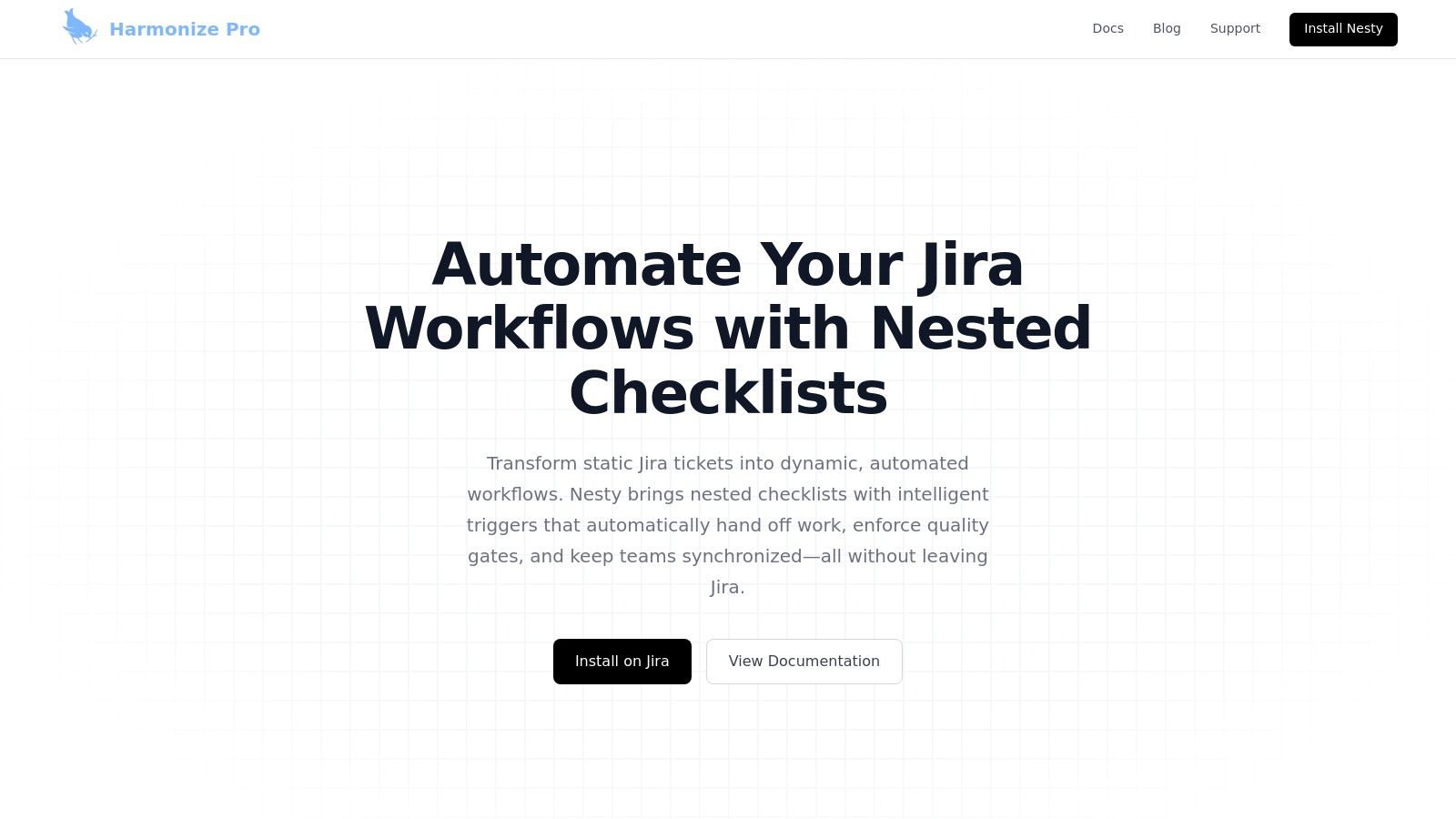
Harmonize Pro offers Nesty, a powerful Jira-native application designed to transform static Jira tickets into dynamic, self-managing workflows. It excels by embedding complex, multi-step processes directly within a single Jira issue, eliminating the manual coordination and confusion that plagues cross-functional teams. For organizations needing to build auditable, automated, and enforceable sample Jira workflows, Nesty provides a robust framework.
The platform’s core strength is automating handoffs and enforcing quality gates. Instead of relying on team members to manually reassign tickets or remember to notify the next person, Nesty’s smart triggers handle it automatically. This ensures that processes like developer-to-QA handoffs or multi-environment deployments are not just mapped out but are actively managed by the system itself, preserving sequence and visibility.
Strategic Analysis: Building Intelligent Workflows
Nesty's standout features—unlimited nested checklists and smart triggers—are the building blocks for creating highly structured and intelligent workflows. This approach allows teams to model reality more accurately than a flat Jira workflow ever could.
- Unlimited Nested Checklists: Break down large processes (like customer onboarding) into manageable, hierarchical tasks. Each parent task can contain sub-tasks with their own checklists, creating a clear, auditable structure inside one Jira issue.
- Smart Triggers & Automation: Configure rules that automatically reassign the ticket, notify a Slack channel, or require an artifact (like a test plan PDF) to be attached before a checklist item can be completed. This moves process enforcement from manual policing to system-driven compliance.
- Enforceable Quality Gates: Use blockers to ensure a ticket cannot progress until specific criteria are met. Build a "Definition of Done" for a development task as a checklist where every item must be completed before the ticket can be automatically handed off to the QA team. This prevents premature transitions and ensures quality at each stage.
Actionable Takeaways & Practical Applications
Harmonize Pro's website provides pre-built workflow examples that serve as excellent starting points. You can install Nesty directly from the Atlassian Marketplace and begin modeling your unique processes immediately.
| Workflow Example | Key Nesty Features Used | Actionable Insight |
|---|---|---|
| Dev → QA Handoff | Blockers, Automatic Reassignment, Slack Notifications | Build a "Ready for QA" checklist. Use a trigger to auto-reassign the ticket to the QA lead and post a message in the #qa-team Slack channel only after all dev checklist items are complete. |
| Multi-Env Deployments | Nested Checklists, Artifact Requirements, Role-Based Triggers | Create a parent checklist for the release with nested checklists for "Deploy to Staging" and "Deploy to Production." Require a "QA Sign-off" PDF to be attached before the production checklist can be started. |
| Customer Onboarding | Hierarchical Checklists, Automatic Notifications | Model the entire onboarding journey in one ticket. Use smart triggers to notify the customer success manager when the technical setup is complete, ensuring a seamless handoff from the implementation team. |
Strategic Insight: The true power of Nesty is its ability to centralize context. Instead of scattering a process across multiple linked tickets or external documents, the entire history, sequence, and audit trail are contained within a single, self-orchestrating Jira issue.
While Harmonize Pro provides extensive documentation, plan for an initial setup period to map your processes and configure automation rules. This investment pays off by encoding best practices directly into your Jira instance. The company's blog also offers valuable guidance on implementation; you can learn more about improving Jira workflows on Harmonizepro.com.
Key Details:
- Access: Nesty can be installed directly from the Atlassian Marketplace.
- Pricing: Pricing information is not publicly listed; teams must contact Harmonize Pro for licensing details.
- Pros: Deep automation, enforces quality gates, centralizes complex processes in one ticket.
- Cons: Requires a dedicated setup effort, only available for Jira.
2. Atlassian Marketplace
Website: https://marketplace.atlassian.com
The Atlassian Marketplace is the official app store for expanding Jira's capabilities. For teams searching for sample Jira workflows, it's the most direct route to finding, testing, and implementing pre-built processes directly within Jira Cloud. Instead of building from scratch, you can leverage workflows created by trusted vendors.
The key feature for workflow discovery is the “Import from Marketplace” function within Jira’s workflow editor. This allows you to pull a vendor-provided workflow template directly into your Jira instance, creating a fully functional draft that can be used as-is or customized. This significantly lowers the barrier to entry for complex processes like multi-stage DevOps deployments or intricate QA testing cycles.

Strategic Breakdown and Actionable Insights
The Marketplace is a strategic tool for rapid process iteration. Many of the listed workflows are bundled with apps that provide enhanced conditions, validators, and post-functions far beyond Jira's native toolkit. These apps are often where the real power lies, enabling sophisticated automation and validation gates. Beyond the native options, the Atlassian Marketplace offers a wealth of solutions, including some of the best Jira integrations to optimize your web development workflow.
Actionable Takeaway: Before building a complex workflow, search the Marketplace for apps that solve your core problem (e.g., "release management" or "QA test cycles"). Often, these apps come with a sample workflow that is already optimized for their specific features, saving you dozens of hours in configuration and testing.
Key Features and Practical Tips
| Feature | Description | Practical Tip |
|---|---|---|
| Direct Workflow Import | Install workflow templates directly from the Marketplace into your Jira Cloud instance. | Always install and test a new workflow in a sandbox or development Jira project first. Never import directly into a live production project without thorough vetting. |
| App-Bundled Workflows | Many apps for automation, checklists, or approvals include their own sample workflows. | Look for apps with a "Cloud Fortified" badge. This indicates a higher level of security, reliability, and support vetting from Atlassian. |
| Free Trials | Nearly all paid apps offer a free trial period (typically 30 days). | Use the trial period to fully evaluate not just the app, but also its accompanying workflow. Does it fit your team's process? Can it be easily modified? |
| Vendor Documentation | Listings include links to vendor documentation, support portals, and version history. | Check the "Versions" tab to ensure the app is actively maintained and compatible with your Jira version (Cloud, Data Center, or Server). |
Pros and Cons
- Pros:
- The easiest and most integrated way to install and test sample workflows.
- Centralized location for comparing apps, pricing, and vendor reputation.
- Security and reliability signals (like partner levels) help in vendor selection.
- Cons:
- Workflow quality varies significantly between vendors.
- Listings can be confusing; you must filter carefully for Jira Cloud compatibility.
- The best workflows are often tied to paid apps, not available standalone.
3. Jira Templates Library (Atlassian)
Website: https://www.atlassian.com/software/jira/templates
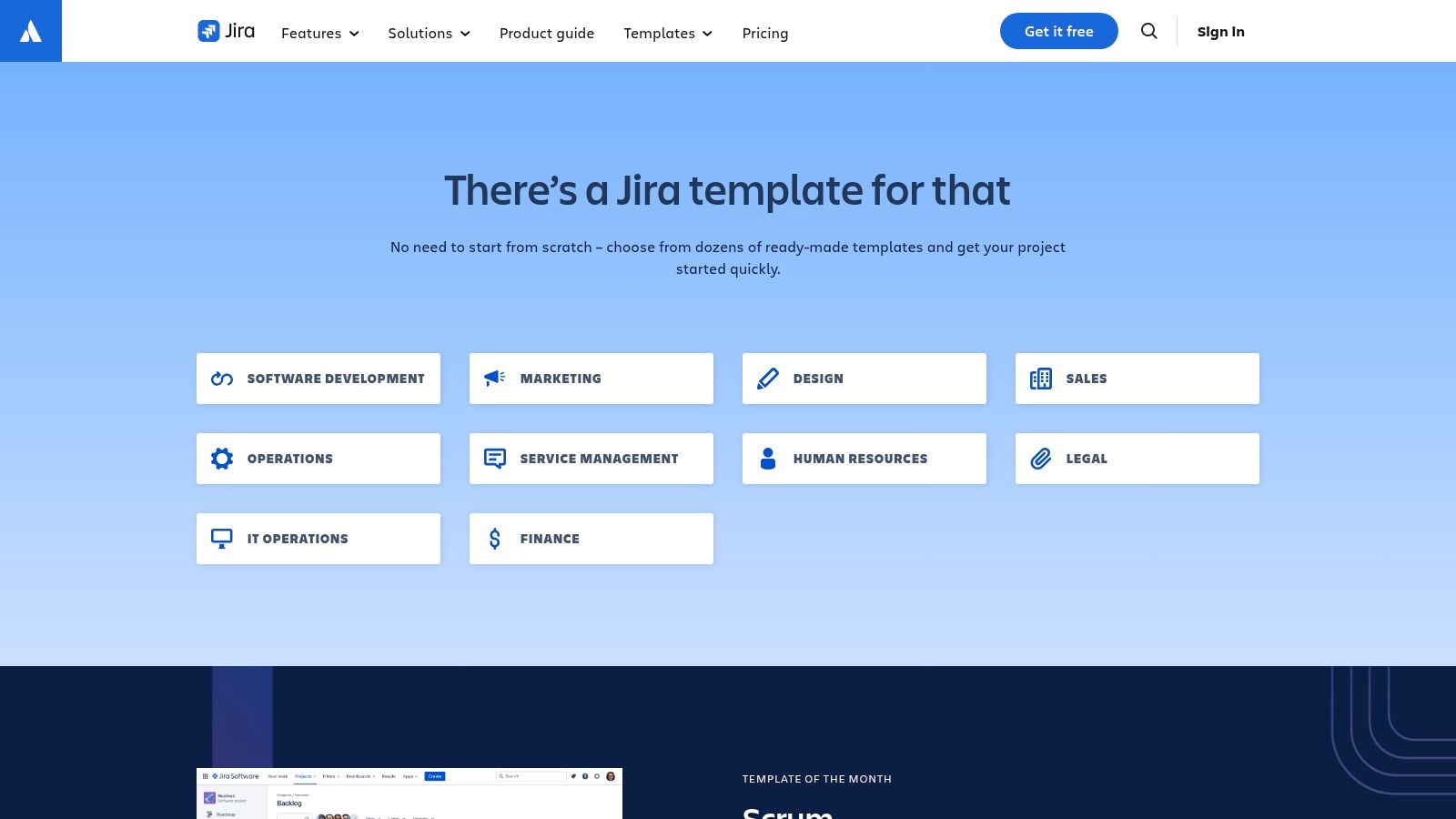
Atlassian’s own Jira Templates Library is the most accessible starting point for finding sample Jira workflows. Integrated directly into the Jira Cloud project creation process, these templates offer turnkey solutions that include pre-configured boards, issue types, and fundamental workflows for various teams. This resource is designed to eliminate initial setup friction, allowing you to launch a structured project in minutes.
The library's main advantage is its native integration. When you create a new project in Jira, you are prompted to select a template like "Scrum," "Kanban," or "Bug Tracking." Each choice automatically generates a project with an opinionated workflow, providing a ready-made foundation of statuses and transitions that can be immediately used or customized to fit your team's specific needs.
Strategic Breakdown and Actionable Insights
The Jira Templates Library serves as both an educational tool and a baseline for process standardization. While the workflows are intentionally simple, they are perfect for new teams or for introducing non-technical departments to structured agile processes. Use these templates as a "version 1.0" of your process, then iterate by adding automation rules, custom fields, and more granular transitions as the team matures. Adhering to fundamental principles is key; you can explore some of the Jira workflow best practices to ensure your customizations are effective.
Actionable Takeaway: When starting a new project, always begin with the closest matching template from the library. Instead of creating a workflow from a blank slate, use the template to handle 80% of the standard setup. Then, focus your administrative efforts on customizing the last 20% to address your team's unique needs, like adding a specific "Peer Review" status or an automated transition for "QA Approved."
Key Features and Practical Tips
| Feature | Description | Practical Tip |
|---|---|---|
| Native Project Templates | Pre-packaged project configurations with workflows, issue types, and board settings. | For a software team, start with the "Scrum" or "Kanban" template and immediately review the workflow diagram. Identify which statuses are unnecessary and which are missing before inviting the full team. |
| Team-Specific Blueprints | Templates are categorized by team type, such as Software, Business, and Service Management. | Don't be limited by the category name. The "Onboarding" template under Business, for example, can be adapted for a technical customer implementation process. |
| Integrated Tutorials | Many templates come with in-product guidance and links to documentation on best practices. | Use the template's default setup for a full sprint. This hands-on experience will reveal its limitations and inform your customization priorities much faster than theory-crafting. |
| Simple Workflow Editor | The default workflows can be easily edited using Jira's visual workflow editor. | Clone the default workflow before making changes. This creates a backup and allows you to switch back to the original if your customizations cause issues. |
Pros and Cons
- Pros:
- Completely free and natively integrated into Jira Cloud.
- Extremely low friction for exploring and deploying baseline workflows.
- Excellent for aligning non-technical teams on common patterns like Scrum or Kanban.
- Cons:
- Workflows are basic and lack the complex validators or conditions of Marketplace apps.
- Advanced automation and gating require building separate Jira Automation rules.
- Less suitable for highly regulated or complex, multi-stage processes out of the box.
4. Jira Automation Template Library (Atlassian)
Website: https://www.atlassian.com/software/jira/automation-template-library
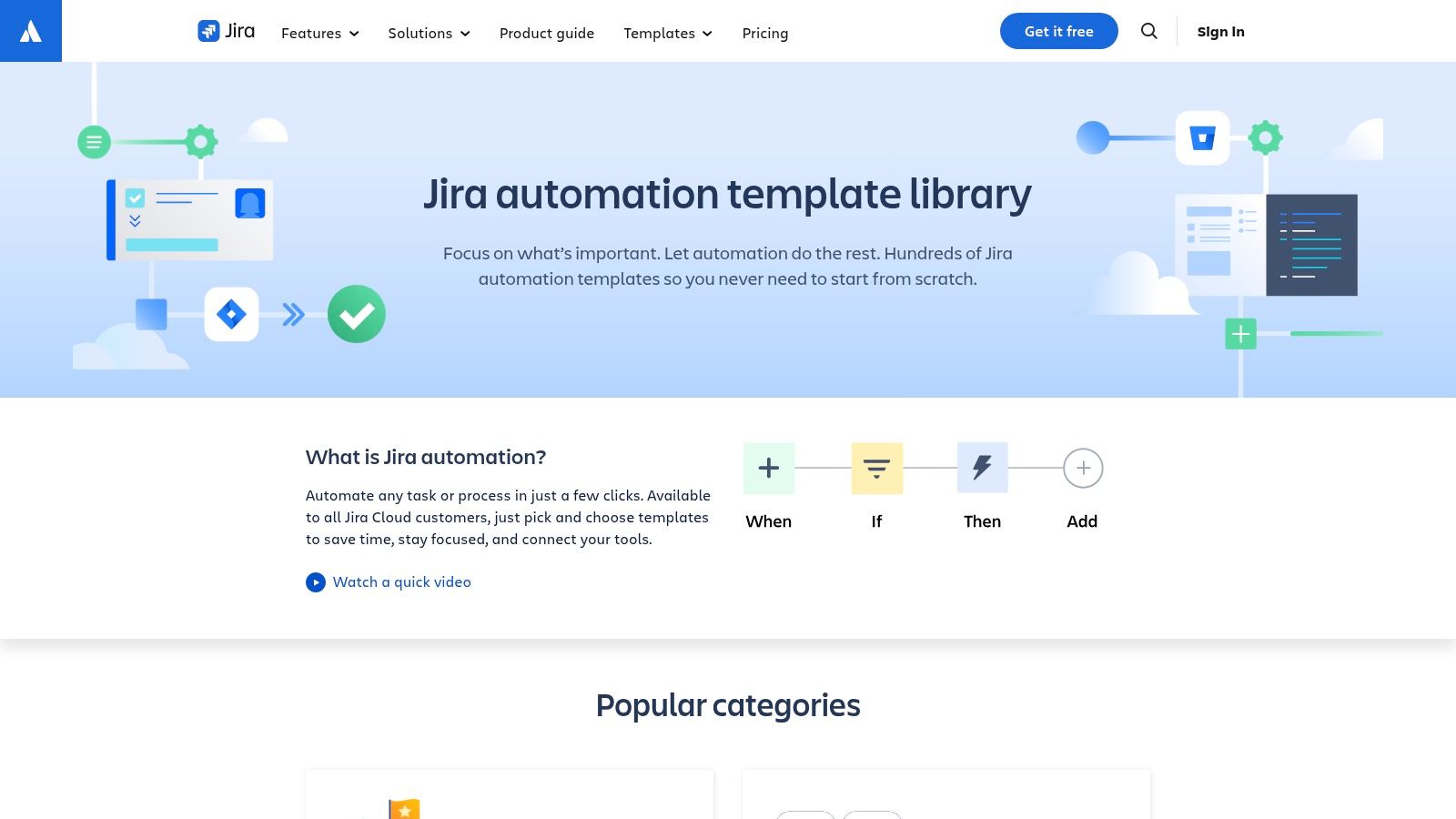
While a workflow defines the path an issue can take, automation rules define the actions that happen along that path. The Jira Automation Template Library is Atlassian’s official gallery of pre-built automation rules that enhance your workflows. For teams seeking effective sample Jira workflows, this library is a critical resource for adding the logic, gates, and smarts that make a process work, without needing to write any code.
These templates offer functional components you can copy directly into your Jira instance. For example, you can find rules to automatically transition an issue when a pull request is merged, assign a sub-task when a parent issue moves to "In Progress," or notify a Slack channel when a high-priority bug is created. This turns a simple workflow into an intelligent, automated system.
Strategic Breakdown and Actionable Insights
The Automation Template Library is the key to moving from a passive workflow (where users manually update everything) to an active one (where the system enforces rules and handles routine tasks). These templates are not just time-savers; they are process-enforcers. They ensure that quality gates are met, handoffs are seamless, and required information is captured at the right stage.
The real power comes from combining multiple templates. You can use one rule to auto-create QA sub-tasks when a story enters the "Ready for QA" status, another to transition it back to "In Progress" if a QA sub-task is marked as "Failed," and a third to close the parent story when all QA sub-tasks are "Done." This creates a robust, self-managing testing cycle.
Actionable Takeaway: Browse the library by integration (e.g., "GitHub" or "Slack"). Many of the most powerful workflow automations are triggered by external events. Implementing a rule like "When pull request merged -> Transition to Done" can eliminate one of the most common manual update steps for development teams.
Key Features and Practical Tips
| Feature | Description | Practical Tip |
|---|---|---|
| One-Click Rule Import | Copy any template from the library directly into your project's automation rules with a single click. | Start with simple, high-impact rules like auto-assigning issues or adding comments. This helps your team get comfortable with automation before you implement more complex, transition-based rules. |
| Automation Playground | A safe, sandboxed environment to test and experiment with automation rules without affecting your live projects. | Use the Playground to understand how triggers, conditions, and actions interact. It's perfect for de-risking a complex rule before deploying it to a critical workflow. |
| First-Party Integration Patterns | Official, battle-tested templates for connecting Jira with tools like Slack, Microsoft Teams, GitHub, and Bitbucket. | Prioritize these official integration templates. They are maintained by Atlassian and are less likely to break during platform updates compared to custom-built solutions. |
| Category-Based Filtering | Templates are organized by function, such as DevOps, ITSM, approvals, and issue management. | When designing a new workflow, first sketch the statuses and transitions. Then, use the library's categories to find automation rules that can manage each step of that workflow. |
Pros and Cons
- Pros:
- Free to use for all Jira Cloud customers (with plan-based execution limits).
- Dramatically speeds up the process of adding logic and enforcement to any workflow.
- No coding required, making it accessible to project managers and team leads.
- Helps maintain process consistency and reduces manual errors.
- Cons:
- Automation execution limits are tied to your Jira pricing plan (e.g., Free, Standard, Premium).
- Some complex conditional logic or multi-project rules may still require a higher plan or a third-party app.
- It's a library of rules, not complete workflows, so you still need to design the core workflow structure yourself.
5. JSU Automation Suite for Jira Workflows (Appfire)
Website: https://appfire.com/products/jsu
JSU Automation Suite by Appfire is one of the original and most powerful no-code workflow engines for Jira. While not a direct repository of downloadable workflows, it acts as a critical accelerator, providing the building blocks to transform a basic sample Jira workflow into a powerful, automated, and production-ready process. It bridges the gap between Jira's native capabilities and the complex validation and post-function logic that sophisticated workflows demand.
The suite operates directly within Jira's workflow editor, adding a vast library of new conditions, validators, and post-functions. This allows you to implement advanced rules without writing code. For example, you can enforce that a "QA Approved" status can only be set if all linked sub-tasks are resolved, or automatically create a follow-up "Documentation" task when an issue moves to "Done".
Strategic Breakdown and Actionable Insights
JSU's strategic value lies in its ability to enforce process integrity and automate manual steps, turning a simple workflow diagram into a self-regulating system. Instead of relying on team members to remember complex procedural rules, you embed those rules directly into the workflow itself. For a deep dive into how such tools transform processes, you can learn more about Jira workflow automation. The app's power is in combining multiple functions to create robust gates and triggers that guide users to follow the correct procedure every time.
Actionable Takeaway: Identify the biggest bottleneck or point of human error in your current workflow. Search the JSU documentation for a post-function or validator that directly addresses it. For instance, if developers forget to update a field when closing an issue, use JSU's "Update Any Issue Field" post-function on the "Done" transition to automate it.
Key Features and Practical Tips
| Feature | Description | Practical Tip |
|---|---|---|
| No-Code Workflow Functions | A large library of conditions, validators, and post-functions accessible via a point-and-click interface. | Start by enhancing a simple workflow. Add a validator to check if a specific field (like 'Story Points') is filled before an issue can be moved to "In Progress". |
| Linked Issue Synchronization | Automate actions on linked issues, such as transitioning a parent story when all its sub-tasks are completed. | Use this for epic management. Create a post-function to automatically close an epic when its last child story moves to the "Done" status column. |
| Advanced Field Control | Functions to make fields required, read-only, or hidden based on the issue's status or user's role. | During a "Code Review" status, use a JSU function to make the 'Assignee' and 'Story Points' fields read-only to prevent scope creep during the review phase. |
| Vendor Documentation & Support | Comprehensive documentation with examples for common use cases like approval chains and escalations. | Bookmark the JSU "Use Cases" section on the Appfire website. It provides excellent starter patterns and ideas for replicating common business processes. |
Pros and Cons
- Pros:
- Empowers non-developers to build highly sophisticated and automated workflows.
- Vastly extends Jira's native workflow capabilities with minimal effort.
- Excellent documentation and vendor support from a trusted "Cloud Fortified" partner.
- Cons:
- It is a paid app, adding a recurring license cost to your Jira instance.
- Requires careful planning to avoid creating overly complex or conflicting workflow rules.
- Long-term use requires budgeting and dependency on the app's license.
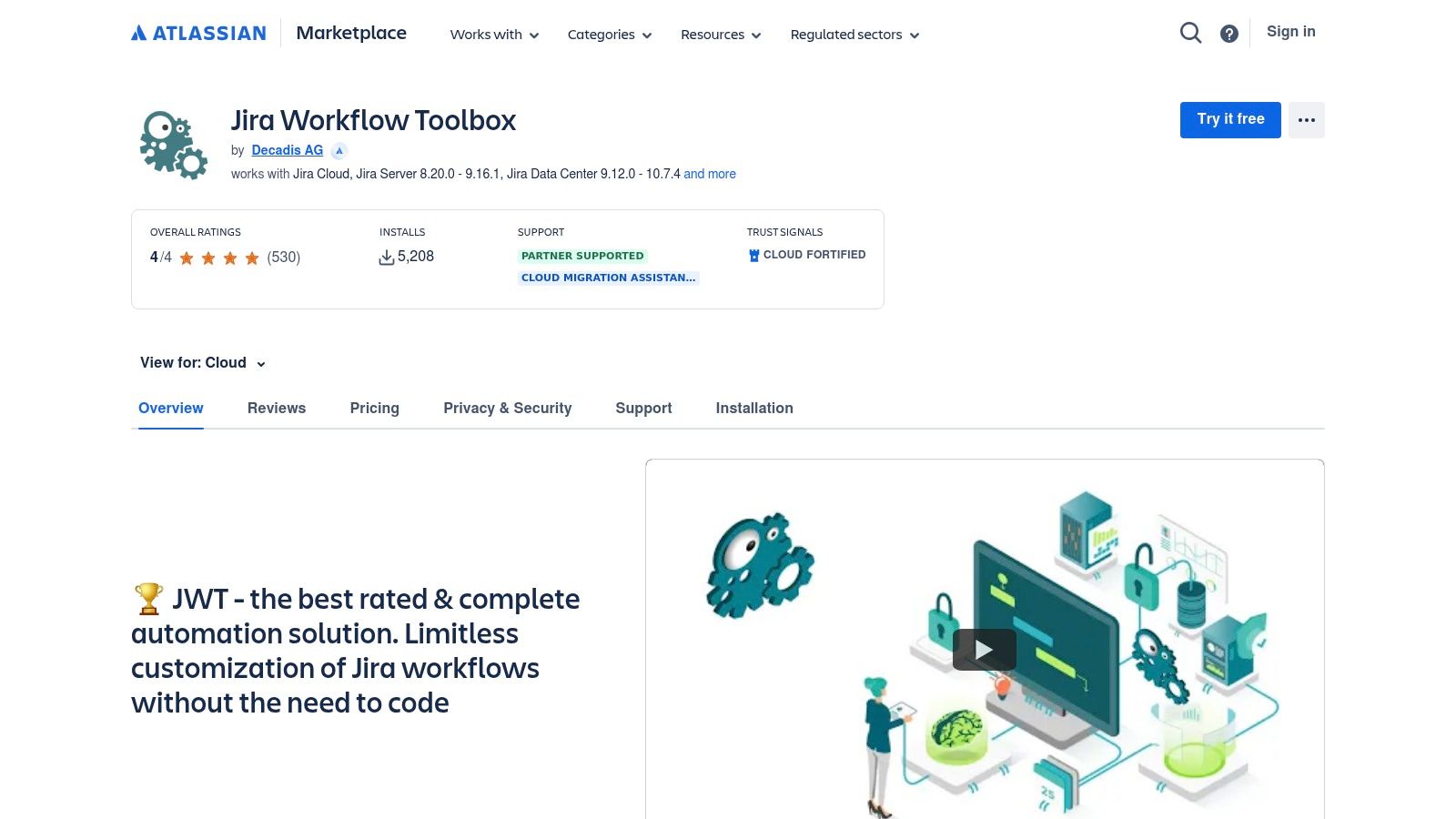
6. Jira Workflow Toolbox (Decadis)
Website: https://marketplace.atlassian.com/apps/29496/jira-workflow-toolbox
Jira Workflow Toolbox is not a repository of full workflows but a powerful Jira app that supercharges the workflow editor. It provides a suite of advanced post-functions, conditions, and validators that enable highly sophisticated, rule-based automations. For teams needing sample jira workflows that go beyond simple status changes, the app's documentation provides practical "workflow helpers" and configuration examples that act as mini-templates for complex logic.
The app stands out by allowing administrators to build dynamic and compliant workflows that would otherwise require custom scripts. For example, you can implement transitions that are only available if a sub-task is in a specific state, or post-functions that calculate and set field values based on complex Jira Expressions. This makes it an essential tool for regulated industries or teams requiring strict process enforcement.
Strategic Breakdown and Actionable Insights
Jira Workflow Toolbox transforms the workflow editor from a state-management tool into a business process engine. Its value lies in creating workflows that self-enforce rules, reducing manual oversight and human error. Instead of just tracking work, the workflow actively manages it by controlling field values, enforcing parent-child relationships, and orchestrating transitions based on precise conditions.
The app's support for Jira Expressions is a game-changer for customization. It allows for dynamic logic based on almost any data point within an issue, from user properties to linked issue statuses. This enables the creation of highly tailored sample jira workflows for use cases like GxP compliance, where every step must be validated, or for complex release gating where multiple criteria must be met before an issue can proceed.
Actionable Takeaway: Use the "Parse fields from text" post-function to automate data entry. For example, configure a workflow transition to scan the description or comments for a specific pattern (like "Version: 2.1.3") and automatically populate the "Fix Version/s" field. This saves time and ensures data consistency.
Key Features and Practical Tips
| Feature | Description | Practical Tip |
|---|---|---|
| Advanced Post-Functions | A vast library of functions to manipulate fields, link issues, and trigger actions after a transition. | Combine the "Copy a parsed text to a field" and "Create/clone issue(s)" post-functions to automatically generate sub-tasks with pre-filled details extracted from the parent issue description. |
| Jira Expression Support | Use Jira Expressions in conditions and validators to create highly dynamic and specific rules. | Use a Jira Expression validator to prevent an issue from transitioning if its linked pull request on Bitbucket has not yet been merged. This creates a hard gate for QA readiness. |
| Workflow Helpers | The app's documentation includes detailed examples for common but complex workflow scenarios. | Before building from scratch, review the official documentation for a helper that matches your goal. The examples provide the exact configuration needed for scenarios like "User is a member of a group." |
| Admin Utilities | Tools to speed up workflow administration, like copying and pasting post-functions between transitions. | When building a complex workflow with repeated logic (e.g., checks on every transition), configure the post-functions once, then use the copy utility to apply them to all relevant transitions quickly. |
Pros and Cons
- Pros:
- Enables extremely powerful and granular control over workflow logic.
- Excellent for building audit-friendly and compliant processes.
- Strong documentation with practical, copy-paste examples for complex scenarios.
- Cons:
- Has a notable learning curve, especially for mastering Jira Expressions.
- The power and flexibility can be overwhelming for simple use cases.
- This is a paid app, requiring a subscription through the Atlassian Marketplace.
7. ScriptRunner Example Scripts (Adaptavist / ScriptRunner)
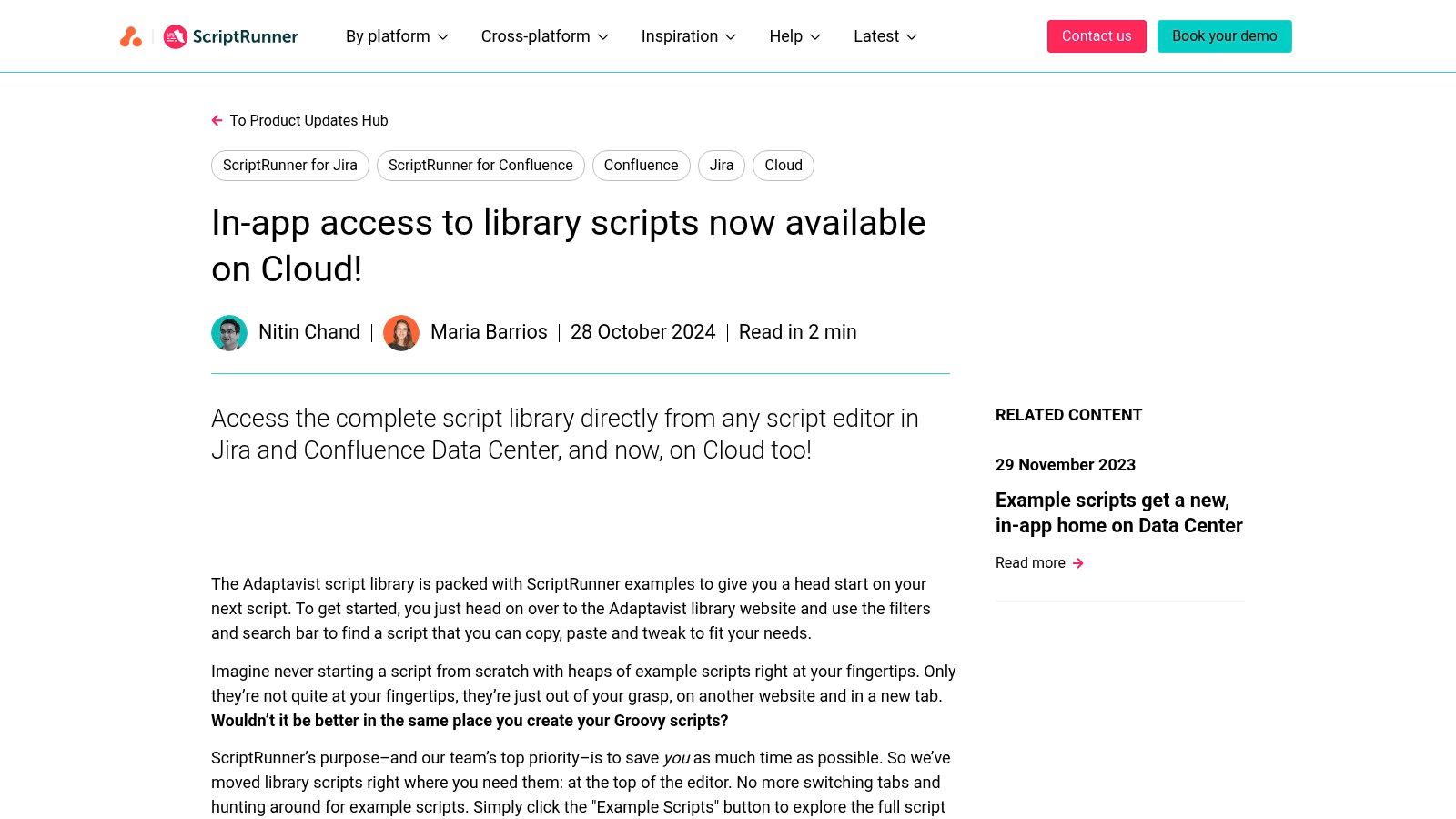
ScriptRunner by Adaptavist is the gold standard for extending Jira’s automation beyond its native limits, and its library of example scripts is an invaluable resource. For teams needing highly customized sample Jira workflows, this platform offers the building blocks to solve complex problems that no-code automation tools cannot handle. It provides hundreds of vetted Groovy scripts for workflow validators, conditions, and post-functions.
The platform's strength is bridging the gap between simple automation and custom development. Instead of searching forums for code snippets, you can access a curated, searchable library of examples directly on the ScriptRunner website or within Jira itself via the app's "Example Scripts" modal. This allows you to find, copy, and adapt working code for your specific use case, dramatically accelerating the development of sophisticated workflow logic.
Strategic Breakdown and Actionable Insights
ScriptRunner's examples are templates for strategic process enforcement. These scripts enable you to build workflows with validation gates that are impossible with native Jira, such as checking fields in linked issues or ensuring a sub-task meets specific criteria before a parent issue can be transitioned. This unlocks a level of process control essential for regulated industries or teams with strict compliance requirements.
Actionable Takeaway: Identify the biggest manual bottleneck in your current workflow. Search the ScriptRunner examples library for keywords related to that problem (e.g., "linked issues," "sub-task," "attachment required"). You will likely find a pre-built script that solves 80% of your problem, requiring only minor tweaks to fit your exact field names and project keys.
Key Features and Practical Tips
| Feature | Description | Practical Tip |
|---|---|---|
| Example Scripts Library | Hundreds of searchable, ready-to-use Groovy scripts for validators, post-functions, and listeners. | Use the website's search and filter functions to narrow down by Jira platform (Cloud/Data Center) and script type. The comments within the scripts are excellent learning tools. |
| In-App Script Modal | Browse, filter, and copy example scripts directly within the ScriptRunner interface inside Jira. | When using the in-app modal, pay close attention to the context. The modal often filters examples relevant to the specific workflow function you are editing, saving you time. |
| Detailed Documentation | Each example is accompanied by explanations and links to relevant product documentation. | Before adapting a script, read the associated documentation to understand the APIs it uses. This will help you modify it correctly and avoid common errors. |
| Low-Code Approach | Scripts provide a robust starting point that often requires only minor modifications. | Start by copying a script and using it in a test project's workflow. Change only one thing at a time (like a custom field ID or project key) to ensure you understand its impact. |
Pros and Cons
- Pros:
- Provides vetted, working code that accelerates custom workflow development.
- Enables extremely powerful and flexible automation for edge cases.
- Speeds up the learning curve for using ScriptRunner and Groovy.
- Cons:
- Requires a paid ScriptRunner for Jira license to implement the scripts.
- A basic understanding of Groovy or scripting logic is necessary for customization.
- Poorly adapted scripts can impact Jira performance if not tested properly.
Top 7 Sample Jira Workflow Tools Comparison
| Solution / Item | Implementation Complexity 🔄 | Resource Requirements ⚡ | Expected Outcomes 📊 | Ideal Use Cases 💡 | Key Advantages ⭐ |
|---|---|---|---|---|---|
| Harmonize Pro (Nesty) | Moderate–High; requires rule design and change management 🔄 | Jira-only; vendor docs/support; admin time; pricing via contact ⚡ | Centralized, auditable self‑managing workflows; fewer missed handoffs 📊 ⭐⭐⭐ | Cross‑functional handoffs, multi‑env deployments, structured onboarding 💡 | Unlimited nested checklists, smart triggers, Slack/Teams integration, audit trails ⭐ |
| Atlassian Marketplace | Low; install/import per app, quality varies 🔄 | Jira Cloud account; evaluate vendors; sandbox testing recommended ⚡ | Fast access to many workflow apps/templates; variable reliability 📊 ⭐⭐ | Finding and testing third‑party workflow tools and importable packs 💡 | Centralized catalog, trials, security/vetting signals (Cloud Fortified) ⭐ |
| Jira Templates Library (Atlassian) | Very low; turnkey templates and boards 🔄 | Native to Jira Cloud; minimal admin effort ⚡ | Ready starter projects and standard workflows; quick alignment 📊 ⭐ | Small or non‑technical teams, quick project bootstraps 💡 | Free, native templates with integrated tutorials ⭐ |
| Jira Automation Template Library (Atlassian) | Low–Moderate; copy and tweak automation rules 🔄 | Jira Cloud; automation execution quotas depend on plan ⚡ | Enforces gates/notifications without code; faster logic adoption 📊 ⭐⭐ | Adding workflow logic, auto‑transitions, notifications, simple gates 💡 | Hundreds of templates, sandbox playground, first‑party integration patterns ⭐ |
| JSU Automation Suite (Appfire) | Moderate; no‑code flows but requires admin setup 🔄 | Paid add‑on license; admin configuration time ⚡ | Production‑ready post‑functions and validators without coding 📊 ⭐⭐ | Admins building approvals, escalations, linked transitions 💡 | Drag‑and‑drop no‑code setup, rich post‑functions, vendor support ⭐ |
| Jira Workflow Toolbox (Decadis) | Moderate–High; expression logic has learning curve 🔄 | Paid app; admin familiarity with expressions recommended ⚡ | Sophisticated branching and compliance checks; audit‑friendly flows 📊 ⭐⭐ | Regulated environments, complex field logic and orchestration 💡 | Extensive post‑functions, validators, Jira Expressions support ⭐ |
| ScriptRunner Example Scripts (Adaptavist) | High if customizing; examples reduce development time 🔄 | ScriptRunner license required; Groovy/low‑code skills helpful ⚡ | Maximum flexibility for edge cases and complex automations 📊 ⭐⭐⭐ | Advanced custom logic, integrations, bespoke workflow behaviors 💡 | Large searchable library of vetted scripts, in‑app examples, deep customization ⭐ |
From Sample to System: Making These Workflows Your Own
We've explored a powerful collection of resources for finding, adapting, and enhancing your Jira processes. From the ready-made templates in the Atlassian Marketplace and Jira's native libraries to the sophisticated customization offered by tools like JSU, Jira Workflow Toolbox, and ScriptRunner, the path to a high-performing workflow is clear. The goal isn't just to copy these examples; it's to use them as blueprints to build a system that perfectly mirrors your team's operational reality.
Each sample workflow, whether for a complex multi-environment deployment or a streamlined customer onboarding process, shows how to bake in quality gates, automate handoffs, and provide stakeholders with the visibility they need. Your objective is to deconstruct these blueprints and apply the underlying principles to your own process challenges.
Key Takeaways: Your Workflow Implementation Checklist
As you move from inspiration to implementation, remember that the most effective sample jira workflows are not rigid prescriptions but flexible frameworks designed for evolution.
- Start with the "Why": Before adding a single status, clearly define the problem you're solving. Are you reducing QA bottlenecks? Improving deployment safety? Your objective will guide every decision.
- Simplicity is a Feature: It's tempting to build a workflow that accounts for every edge case. Resist this. A simpler workflow is easier to understand, adopt, and maintain. Start with the minimum viable process and iterate.
- Automate the Toil: Identify every repetitive, manual task in your process. These are your prime candidates for automation. Use Jira's native automation or advanced tools to handle status updates, notifications, and sub-task creation so your team can focus on high-value work.
- Clarity Over Complexity: Ensure that statuses are unambiguous and transitions are intuitive. A team member should be able to look at an issue and immediately understand its current state and what needs to happen next.
Actionable Next Steps: Putting Theory into Practice
Reading about sample jira workflows is the first step. Now, it's time to build. Here’s how to get started today.
- Conduct a Workflow Audit: Choose one of your existing, high-friction workflows. Map it out on a whiteboard and have the team identify its pain points. Where do tickets get stuck? Where are the communication breakdowns?
- Select a Relevant Template: Based on your audit, browse the resources we’ve discussed. Find a sample workflow that addresses a similar problem. Don't look for a perfect match; look for a solid foundation to build upon.
- Customize and Test in a Sandbox: Never roll out a new workflow directly into production. Use a Jira sandbox or a staging project to build and test your new process. Have team members run test issues through the entire workflow to catch any confusing steps or broken logic.
- Document and Train: Once you're confident in the new workflow, create simple, clear documentation. A one-page visual guide is often more effective than a lengthy document. Hold a brief training session to walk the team through the changes and explain the "why" behind them.
Ultimately, your Jira instance should be a strategic asset, not just a task tracker. By thoughtfully selecting, adapting, and implementing the right workflow, you transform your processes from a series of disjointed tasks into a streamlined system that accelerates delivery, enhances quality, and empowers your team to do their best work.
Ready to elevate your workflow with powerful, built-in checklists and gating? Harmonize Pro integrates directly into your Jira issues, allowing you to build the sophisticated quality gates and standardized processes we've discussed without complex configuration. See how you can enforce critical steps and streamline your Jira workflows by visiting Harmonize Pro.
Leave a Reply